SaaS Email Marketing: Complete Guide for 2025
Discover how SaaS email marketing boosts your conversions, reduces churn and retains your users with proven strategies.
What is SaaS Email Marketing and why is it essential in 2025?
In an increasingly saturated digital ecosystem, SaaS companies face a major challenge: acquire, convert and retain users in an ultra-competitive global market. However, among all the available channels, email marketing remains, even today, one of the most profitable levers with an average return on investment of €36 for each euro spent (source: Litmus, 2023).
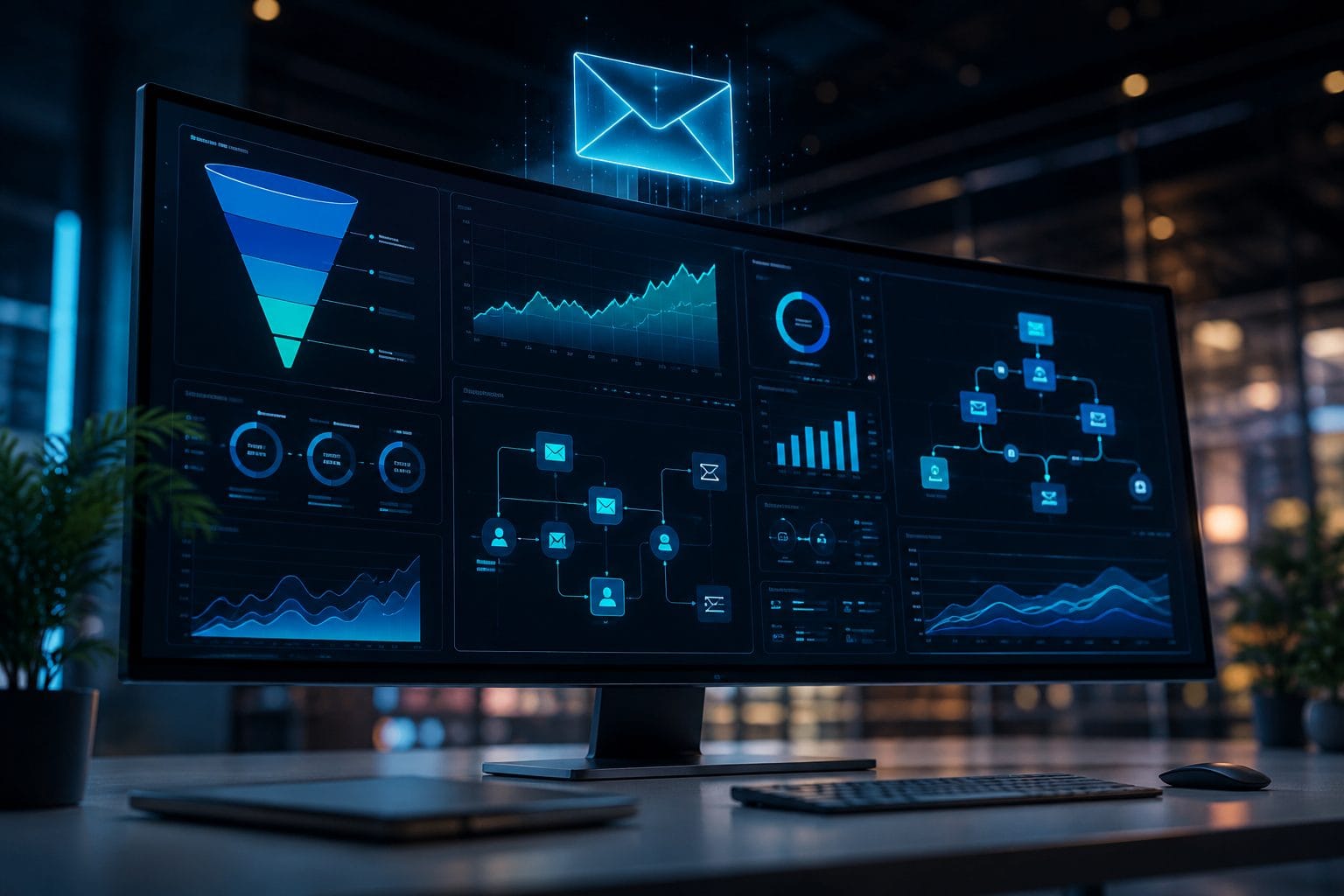
SaaS email marketing refers to all the emailing strategies deployed by companies offering software in subscription mode (Software as a Service). Unlike traditional e-commerce, a SaaS campaign does not only aim to trigger a single purchase. It seeks to support the user throughout their life cycle: from product discovery to long-term loyalty, including activation, conversion and reactivation.
In Morocco, where the SaaS market is accelerating — particularly in the Fintech, EdTech and e-commerce sectors — this discipline represents a major strategic opportunity for digital startups and SMEs wishing to structure their growth. If you're thinking about developing your web platform, integrating email marketing by design can make a huge difference.
The different types of emails in a SaaS strategy
A well-structured SaaS email marketing strategy is not limited to weekly newsletters. It is based on three main categories of emails, each meeting a specific objective.
1. Marketing emails
These are classic promotional communications intended to generate interest and conversions. We find there:
- Newsletters: like those from Ahrefs, which always open with a viral meme to capture attention before delivering content with high added value.
- Promotional offers: for example, Squarespace regularly offers 20% discounts with a clear CTA and a clearly visible expiration date.
- Event invitations: SurveyMonkey uses webinar invitation emails with a clean format — catchy title, event details, speaker list and a clearly visible action button.
Actionable tip: To maximize the impact of your promotional emails, include a dynamic countdown timer. This simple element can increase conversion rates by 8-15% by increasing the sense of urgency.
2. Lifecycle Emails
This is the most strategic category for any SaaS publisher. These emails are triggered automatically based on user behavior and their progress in the customer journey.
The welcome email
It marks the start of the relationship. Hemingway App, for example, sends a structured welcome email that details the benefits of the 14-day free trial and immediately invites the user to explore the product.
The onboarding sequence
This is often the most decisive sequence for retention. Softr intelligently fragments its onboarding into several progressive stages: a first email with resource links, then a second automated one as soon as the user creates their first application.
Key stat: Users who complete structured onboarding are 68% more likely to become paying customers (source: Intercom).
The progress email (Progress Update)
Grammarly perfectly illustrates this mechanism with its personalized weekly reports presented in the form of gamified infographics. These emails reinforce engagement by promoting the user's accomplishments.
The conversion email to the paid plan
The goal here is to turn freemium or free trial users into paying subscribers. Brevo, for example, sends a targeted email after the onboarding sequence, inviting users to upgrade to a higher plan. An additional good practice: automatically trigger an email as soon as a user tries to access a feature reserved for paid plans.
Subscription renewal email
Essential to avoid involuntary unsubscriptions. Serpstat sends this reminder three days before expiration, optimal timing. Please note: Visa regulations impose a minimum period of 7 days for any automatic recurring billing.
The reactivation email (Winback Email)
It is often more profitable to reactivate a lost subscriber than to acquire a new customer. Pipeline intelligently combines satisfaction survey and invitation to reconnect in a single post-cancellation email — without being intrusive.
3. Transactional emails
These emails are triggered by specific user actions within the product. They do not require explicit consent and are sent via a dedicated SMTP protocol to ensure optimal deliverability.
Common examples:
- Action confirmation (registration, account modification)
- Password reset — Pinterest gives a minimalist and effective example
- Collaboration notifications — Deel uses these emails to alert stakeholders when a contract is awaiting their signature
- Technical incident communications — Zapier stands out for proactive and transparent communication during outages, with a closure email once the problem is resolved
The 7 best practices for a successful SaaS email marketing strategy
Knowing the types of emails is one thing. Deploying them effectively is another. Here are the practices that make the difference between a strategy that performs and one that goes unnoticed in inboxes.
Choosing the right emailing platform
The choice of tool is fundamental. A SaaS platform has specific needs that traditional e-commerce businesses do not have. Here are the non-negotiable criteria:
- Management of marketing AND transactional emails in a unified interface
- Behavioral automation workflows: triggering based on in-app actions
- Robust email API to integrate sending into your technical infrastructure
- Scalable pricing that doesn't explode as your list grows
- Integrated CRM or native connection with your commercial management tool
Platforms like Brevo, ActiveCampaign or Customer.io meet these criteria for growing SaaS teams.
Take care of deliverability from the start
80% of email marketing performance issues are related to deliverability, not email content. To maximize your chances of landing in the main box:
- Authenticate your domain with SPF, DKIM and DMARC
- Carry out a progressive warm-up of your sending IP address
- Keep your spam rate below 0.3% (Gmail/Yahoo requirement since 2024)
- Clean your list regularly to remove invalid or inactive addresses
- Include a one-click unsubscribe link in each email
Build a machine to generate qualified leads
Before sending emails, you need relevant contacts. Techniques that actually work — even for startups without an established reputation — include:
- Gated content: guides, templates, checklists downloadable in exchange for an email
- Sector reports: an original study on your market can generate up to +400% of leads via its distribution on social networks
- Free tools like Moz with its suite of SEO tools offered as lead magnets
- Targeted social media advertising to amplify your reach beyond your organic audience
- Webinars co-organized with complementary partners to access their audience
Segment and personalize intelligently
A generic email sent to your entire base is, at best, ignored. At worst, it damages your reputation as a sender. Behavioral segmentation allows you to send the right message, to the right person, at the right time.
Essential segmentation criteria for a SaaS business:
- Current plan (freemium, trial, paid, churned)
- Activation level (has he completed the key stages of onboarding?)
- Use frequency (active vs. inactive user)
- Features used (or not used)
- Company size and industry (for B2B SaaS)
Measure the right performance indicators
Metrics to absolutely follow in a SaaS email marketing strategy:
| Indicator | SaaS benchmarks |
|---|---|
| Open rate | 25–35% |
| Click-Through Rate (CTR) | 2.5–5% |
| Conversion rate | 1–3% |
| Churn rate | <0.5% |
| Annual churn rate (target) | 5–7% |
When should you really get started?
There is no universal ideal time to start SaaS email marketing. But here are clear signals that you're ready:
✅ You generate leads regularly via your site, your advertisements or your SEO
✅ You have launched your product and have an active user base
✅ You have mapped your target’s customer journey
✅ You want to reduce your churn and increase customer lifetime value (LTV)
✅ You are considering upselling or cross-selling strategies
Conversely, postpone the launch if you don't yet have an audience, if you lack the resources to maintain a consistent cadence, or if you want to contact prospects via purchased or scraped lists — this case requires a separate cold emailing strategy.
For Moroccan businesses in their growth phase, SaaS email marketing is often the missing link between acquisition and retention. If you wish to structure your approach with the help of professionals, do not hesitate to contact our team of experts for a personalized audit of your digital strategy.
Conclusion: SaaS email marketing, a long-term investment
SaaS email marketing is not a simple acquisition channel. It is a communication ecosystem that supports the user at every stage of their journey, strengthens their relationship with the product and generates sustainable and predictable growth.
In a context where acquisition costs are increasing and loyalty is becoming the central issue of any SaaS strategy, mastering email marketing has become a non-negotiable strategic skill for marketing and product teams.
Whether you are a startup in the launch phase in Morocco or a scale-up looking to optimize your recurring revenue, the time to structure your email strategy is now.
Q: What is the difference between a transactional email and a marketing email in the SaaS context?
A: A transactional email is automatically triggered by a user action (password reset, purchase confirmation) and does not require prior consent. A marketing email is sent in a planned manner with the aim of promoting a product, retaining or converting a user, and requires their explicit consent.
Q: How often should you send emails to your SaaS users?
A: There is no universal frequency: it depends on the type of email and the user's level of engagement. In general, a 7 to 14 day onboarding sequence is recommended, followed by 2 to 4 emails per month for regular marketing communications. The key is to maintain a consistent cadence without overwhelming the inbox.
Q: How to reduce churn rate with SaaS email marketing?
A: Email marketing helps combat churn by identifying inactivity signals and automatically triggering targeted re-engagement emails. Well-designed winback campaigns, combined with educational emails about underutilized features, can significantly improve retention and keep annual churn around 5-7%.
FatimaZahra NAAMY
Co-Founder, Full-Stack Developer & AI Automation Specialist
Passionate about artificial intelligence, FatimaZahra automates complex business processes to boost our clients' productivity.