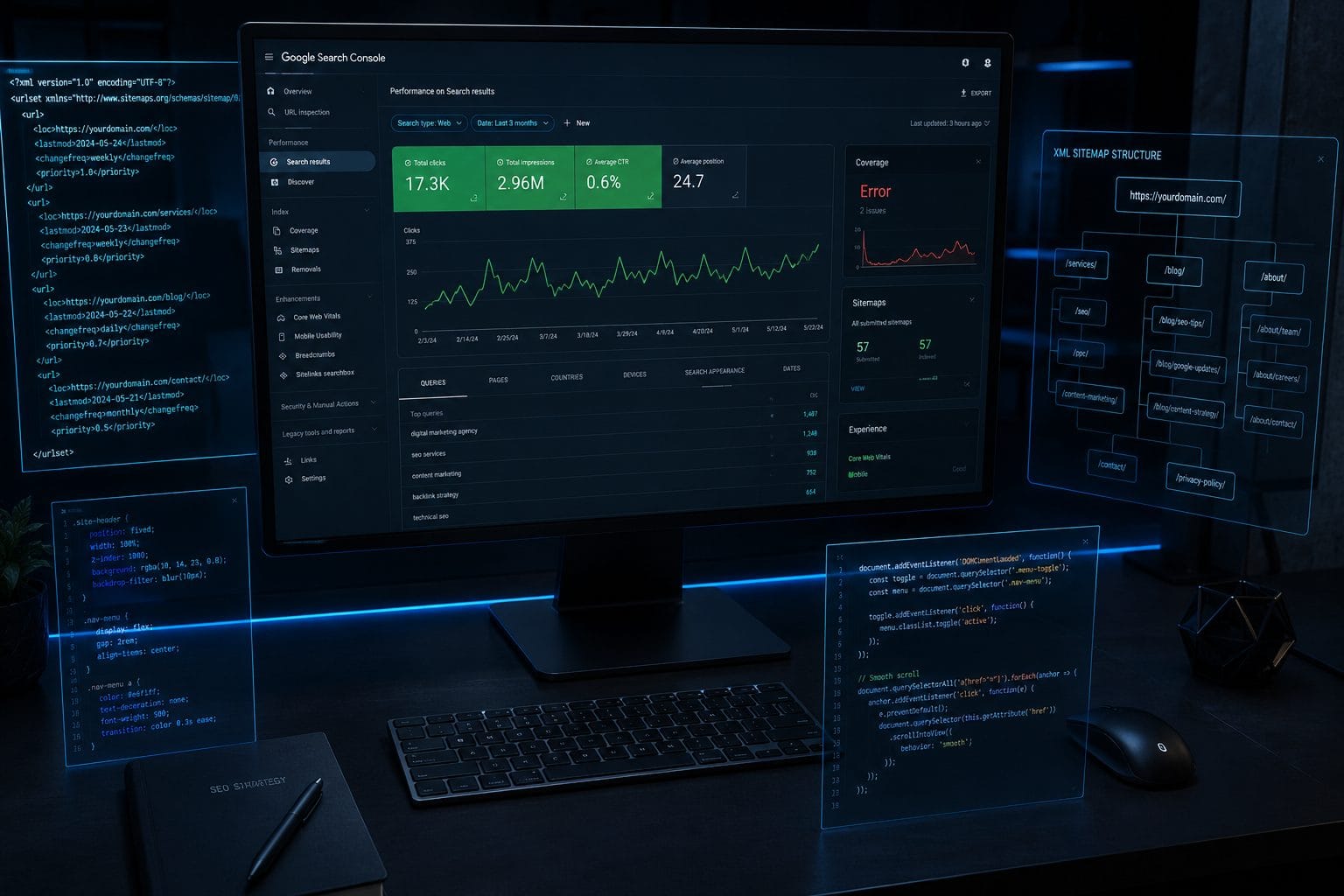
Technical SEO Audit Guide 2025: Rank Higher & Faster
Master the technical SEO audit with our complete 2025 guide. Core Web Vitals, indexability, structured data, and site speed. Propel your website.

By Ahmed Foullane, Lead Developer at AfsimTech Last Updated: June 2, 2026
Many companies spend fortunes on content creation and link building, only to see their traffic stagnate. Why? Because their technical foundation is flawed.
The technical SEO audit is not a mere formality; it is the indispensable prerequisite for any online visibility strategy. If Google cannot crawl, index, or understand your site, the best content in the world will remain invisible.
In this comprehensive guide, we will detail every critical step to perform a technical SEO audit worthy of top agencies in 2025.
Table of Contents
- Indexability and Crawl Budget
- Core Web Vitals (CWV) and Page Speed
- Information Architecture and Internal Linking
- Semantic Markup and Structured Data
- Security and Accessibility
- Conclusion and Quick Audit Checklist
1. Indexability and Crawl Budget
Google's journey begins with discovering your pages. The goal of this step is to ensure that no technical barriers hinder the bots.
The robots.txt File and XML Sitemap
The robots.txt file tells search engines what they should not explore. A simple syntax error can de-index an entire site. Verify that it correctly points to your sitemap.xml, which in turn should only contain HTTP 200 pages (no 301 redirects or 404 errors).
Managing Canonical URLs
Duplicate content is the worst enemy of technical SEO. Ensure that every page has a <link rel="canonical" href="..." /> tag pointing to the absolute reference version. This is particularly crucial for e-commerce sites generating URL parameters (sorting, filters).
lire aussi : Future of Digital Marketing 2026: Trends and Key Strategies
2. Core Web Vitals (CWV) and Page Speed
For several years now, user experience has been an official Google ranking factor. In 2025, the requirements are stricter than ever.
The 3 Pillars of Core Web Vitals
| Metric | What it Measures | Ideal Score (2025) |
|---|---|---|
| LCP (Largest Contentful Paint) | Rendering speed of the largest element | < 2.5 seconds |
| INP (Interaction to Next Paint) | Site responsiveness to user clicks | < 200 milliseconds |
| CLS (Cumulative Layout Shift) | Visual stability (jumping elements) | < 0.1 |
[STAT — à vérifier] A 0.1-second improvement in LCP can increase a site's conversion rates by 8 to 10% in the e-commerce sector.
To optimize these metrics, modern developers rely on next-generation frameworks like Next.js (used by AfsimTech), which pre-generate pages on the server (SSR/SSG) and automatically handle AVIF image optimization.
3. Information Architecture and Internal Linking
A deep site is a poorly indexed site. Your site architecture should respect the "3-click" rule: any page should be accessible in less than three clicks from the homepage.
Siloing and Semantic Cocoons
Organize your content into thematic clusters (silos). Pages dealing with the same subject should be linked together by relevant contextual links. This helps distribute "link juice" (internal PageRank) strategically and helps Google understand your domain expertise.
4. Semantic Markup and Structured Data
If text is for humans, source code is for machines. Structured data (Schema.org / JSON-LD) allows you to provide explicit context to Google.
The Must-Have Schemas
- Organization: To establish your company's credibility (E-E-A-T).
- Article / BlogPosting: Essential to appear in Google Discover and news results.
- FAQPage: To monopolize space in the SERP with "People Also Ask" (PAA) boxes.
"Integrating JSON-LD structured data doesn't always guarantee Rich Snippets, but it accelerates Google's semantic understanding by nearly 30%." Source: Google Search Central – Structured Data Guide
5. Security and Accessibility
Switching to the HTTPS protocol is no longer a debate; it's a requirement. But technical security goes further.
HSTS and Security Headers
Deploy the HSTS (Strict Transport Security) protocol and properly configure your Content Security Policy (CSP) to protect against XSS attacks. Google favors sites that guarantee the security of their users.
Accessibility (WCAG)
Web accessibility and SEO are closely linked. Clean code, descriptive <alt> tags for images, and sufficient contrasts benefit screen readers as much as crawling algorithms.
lire aussi : 10 Essential Strategies to Improve Natural SEO
6. Conclusion and Quick Audit Checklist
Technical SEO is not a one-time task performed during site creation. It is an ongoing process that requires regular monitoring via tools like Google Search Console or Screaming Frog.
Your Quick Audit Checklist:
- Core Web Vitals are green on mobile and desktop.
- No blocking in
robots.txt. - Presence of relevant JSON-LD structured data.
- Canonical tags correctly defined.
- Logical internal linking with no orphan pages.
If the technical aspect overwhelms you, know that the AfsimTech team natively designs "SEO-Ready" web architectures powered by Next.js, guaranteeing you a perfect technical foundation from day one.

Ahmed Foullane
Co-Founder, Lead Full-Stack/Mobile Developer & SEO Expert
Digital engineering expert, Ahmed helps companies design modern, ultra-fast web architectures that are perfectly optimized for search engines.